
Iran’s Threats Against Major U.S. Companies Could Become Crypto’s Next Geopolitical Stress Test
The warning from Tehran is not just another Middle East headline because some of the companies now in the crosshairs sit directly inside the machinery of modern crypto
9 min readApr 2, 2026
This is no longer a distant macro story
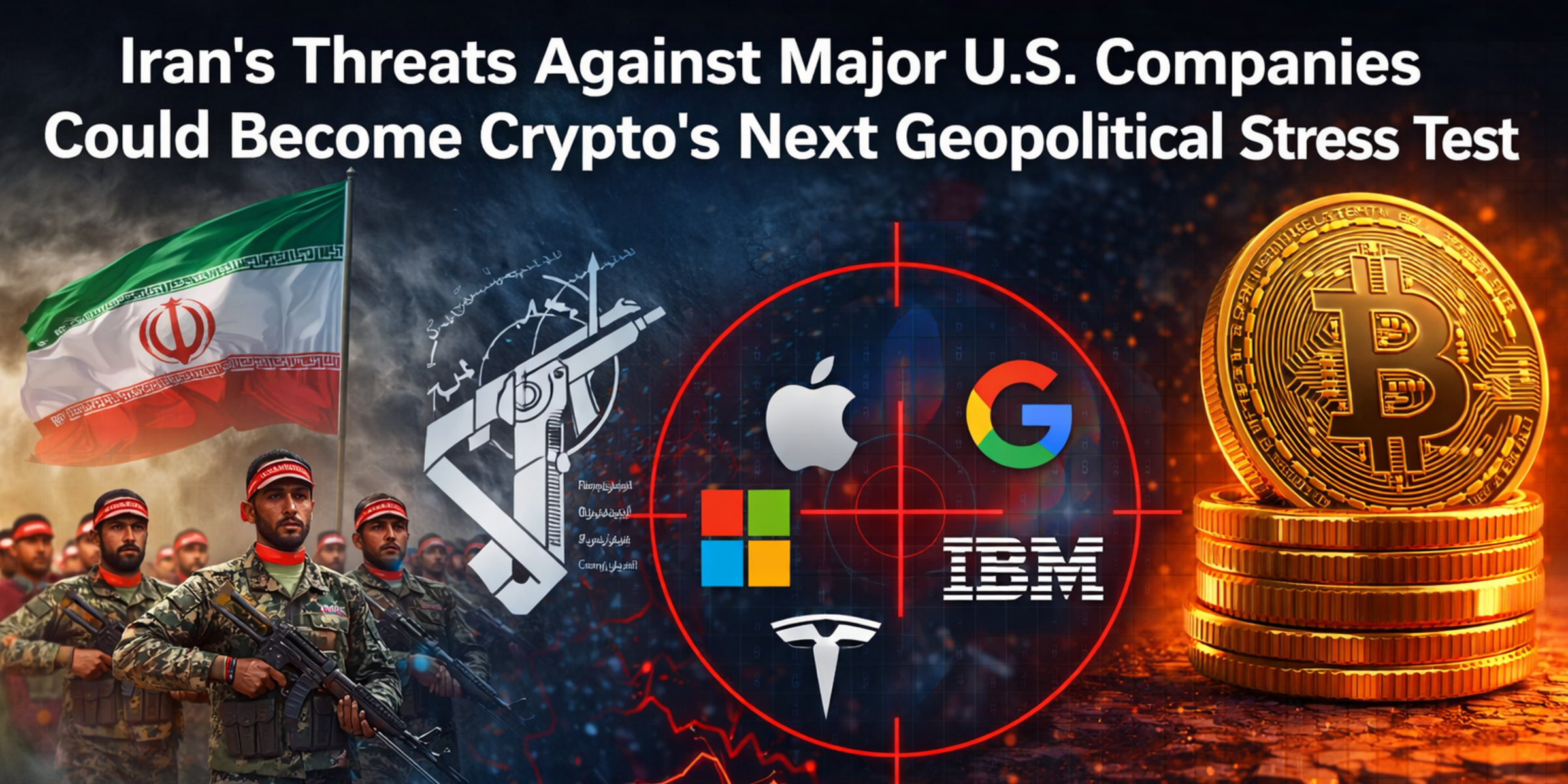
The latest warning tied to Iran should not be dismissed as just another geopolitical flare up that matters only for oil prices and defense stocks. The immediate trigger was a fresh threat from the Islamic Revolutionary Guard Corps against major American firms in the region, with reports naming technology and industrial giants including Microsoft, Google, Apple, Intel, IBM, Tesla, and Boeing. U.S. officials responded by saying they were prepared to thwart any such attacks. That alone would be enough to unsettle markets, but the reason this matters for crypto is more specific. Some of the most important bridges between digital assets and the real economy now run through exactly the kind of large American corporate infrastructure that geopolitical actors increasingly like to threaten.
This is the point many crypto traders still miss. Digital assets are often discussed as though they exist in a parallel universe, detached from the strategic systems that hold up ordinary finance and technology. That was never fully true, and it is even less true now. Crypto increasingly depends on cloud infrastructure, chip supply, payments architecture, large technology vendors, regulated financial rails, and corporate risk appetite. When those layers come under threat, crypto does not float above the chaos. It gets dragged into it. That is why the latest Iran related escalation deserves more attention than a standard market scare. It sits at the intersection of cyber risk, sanctions risk, and the corporate dependencies that digital assets have spent the last few years building into their own system.
The threat is broader than one military headline
The immediate reporting makes clear that the current warning is part of a wider and more dangerous confrontation. Reuters described a conflict environment in which regional escalation, attacks on strategic assets, and threats to American interests have all intensified, while oil prices and broader market anxiety have already reacted sharply. Another Reuters report said the White House was publicly emphasizing readiness to counter Iran linked attacks after the IRGC threats to American firms. That context matters because markets usually handle one headline better than they handle a chain of interlocking risks. What investors are now confronting is not simply a single threat statement, but the possibility of a wider environment in which cyber retaliation, infrastructure disruption, and market stress reinforce one another.
For crypto, that wider setting is especially important because the industry is still trying to present itself as a maturing institutional asset class. It wants pension money, ETF flows, treasury adoption, and deeper integration with payment and trading systems. But integration cuts both ways. The more crypto becomes entangled with mainstream finance and large technology infrastructure, the more it inherits the vulnerabilities of those systems. A regional conflict that seems far removed from token markets can suddenly matter a great deal once it threatens the firms that supply compute, custody, chips, enterprise software, and transaction plumbing. This is one of the central contradictions of crypto’s recent success. The industry has spent years trying to become more connected to the mainstream, but that also makes it more exposed to mainstream geopolitical risk.
Why U.S. companies matter so much to crypto now
The named companies in the threat reporting are not random logos. They represent some of the deepest layers of technological and industrial infrastructure in the global system. Cloud and enterprise software providers matter because exchanges, custodians, analytics platforms, and financial institutions all depend on digital infrastructure at enormous scale. Hardware and semiconductor firms matter because data centers, AI systems, trading systems, and mining operations ultimately run on physical compute and supply chains. Industrial and advanced manufacturing names matter because the line between financial technology, energy systems, and strategic hardware keeps getting thinner. When geopolitical threats target those kinds of firms, the risk is not only direct damage. It is also fear, delay, higher insurance costs, tighter compliance, and a more defensive corporate posture.
That matters for crypto because the market likes to focus on price charts and policy headlines while underestimating the importance of the invisible systems beneath the visible product. Bitcoin can be decentralized at the protocol level and still live inside a world where price discovery depends on large exchanges, where institutional access depends on regulated custodians and brokers, where trading systems depend on cloud and networking infrastructure, and where broader adoption depends on the willingness of major corporate actors to take on political and operational risk. Ethereum can champion programmable finance while still relying on a global environment in which enterprise technology vendors, payments groups, and market infrastructure providers feel safe enough to keep expanding. If that safety begins to look weaker, growth slows even before any direct attack occurs.
My view is that this is why the phrase “new risk for crypto” is stronger than it first sounds. The risk is not just that Bitcoin falls on a scary news cycle. It is that the corporate and financial actors making crypto more mainstream become more cautious at exactly the moment the industry wants them to lean in. In that sense, geopolitics can do damage without a single wallet being touched. A threat environment alone can harden risk committees, freeze expansion plans, and remind mainstream institutions that digital assets still operate inside a messy, strategic world they do not control.
Iran and crypto were already on a collision course
Another reason this story matters is that Iran and crypto were already connected before the latest corporate threats. Reuters reported earlier this year that U.S. authorities had intensified scrutiny of Iran’s growing crypto activity amid concerns that digital asset channels might be helping sanctioned actors move value, access hard currency, or evade parts of the formal financial system. Blockchain analysis cited in that reporting estimated Iranian crypto activity in 2025 in the range of $8 billion to $10 billion, with ongoing debate about how much of that activity was linked to the IRGC or other sanctioned actors. Whatever the precise split, the broader fact is clear. Crypto was already part of the sanctions and enforcement conversation around Iran before the current escalation.
That history matters because it means the present moment is not simply about markets reacting to war news. It is also about a state and a financial technology environment that already have a record of tension. When governments believe crypto can be used to weaken sanctions, bypass banking pressure, or move funds outside ordinary channels, they stop seeing digital assets as just another speculative market. They start seeing them as part of the wider strategic contest. And once crypto is treated that way, every new escalation raises the chance of tighter monitoring, stronger enforcement, and a more openly geopolitical interpretation of digital asset infrastructure.
This is why crypto’s old self image as somehow politically neutral or detached from state conflict looks increasingly thin. A protocol can be neutral in theory and still become entangled in intensely political questions about sanctions, intelligence, cyber operations, and financial sovereignty. Iran’s case has been a reminder of that for some time. The current threat environment just makes the connection much harder to ignore. In my opinion, one of the biggest long term changes in digital assets is that states now care less about crypto as a strange new internet experiment and more about crypto as part of the strategic financial battlefield.
Cyber risk is the part investors still underestimate
The market often reacts to military headlines faster than it reacts to cyber vulnerability, even though the latter can be more relevant to digital assets. Reuters reported last year on a rising surge in cyber and ransomware attacks disrupting global firms across major jurisdictions. That matters here because a threat against large U.S. companies in a geopolitical context does not have to take the form of conventional kinetic damage to create serious fallout. A credible cyber campaign aimed at corporate infrastructure, service availability, software environments, or financial systems could have ripple effects far beyond the immediate target list.
Crypto is particularly sensitive to this because it already lives inside a high threat cyber environment. Exchanges, wallets, bridges, and infrastructure providers are recurring targets even in relatively normal geopolitical conditions. When interstate or state linked cyber aggression overlaps with that baseline, the risk surface gets uglier quickly. Outages, precautionary shutdowns, heightened authentication measures, delayed settlements, service interruptions, and compromised operational confidence all become more plausible. Even if no major crypto platform is directly attacked, the systems it relies on may be forced into a more defensive posture. That can create exactly the kind of friction and uncertainty that digital asset markets hate.
We have already seen how geopolitically motivated attacks can reach into crypto linked environments. Reuters reported in 2025 that an Iranian crypto exchange suffered a major politically charged hack that destroyed around $90 million in cryptocurrencies, an attack analysts described as part of a wider regional cyber conflict. That episode mattered not just because of the money involved, but because it demonstrated how crypto infrastructure can become a symbolic and operational target inside geopolitical struggle. The lesson was simple: when the political stakes rise, digital asset venues do not stand outside the battlefield. They can end up on it.
Markets may be watching the wrong part of the story
The instinctive market reaction to this kind of news is usually to ask whether Bitcoin falls, whether oil rises, or whether the dollar strengthens. Those questions matter, but they can distract from the bigger structural issue. Crypto has spent the last few years trying to normalize itself through institutionalization. That means more ETFs, more corporate exposure, more mainstream custodians, more policy engagement, and more ties to ordinary financial plumbing. In calm times, that looks like maturation. In tense times, it means crypto inherits more of the world’s real fault lines.
This is why I think investors who frame the Iran story only in terms of “risk off” price action are thinking too narrowly. The deeper issue is that digital assets are now exposed to the same strategic risk map as the larger corporate and financial systems they increasingly depend on. If American technology companies in the region face heightened operational or cyber threats, if market infrastructure groups become more cautious, if sanctions enforcement gets tighter, or if enterprise risk appetite retreats, crypto adoption can slow even in the absence of a headline crash. That is a more subtle but in some ways more durable kind of damage.
This is also a reminder that Bitcoin is not the whole story
Another mistake is to think only about Bitcoin when these headlines hit. Bitcoin is the obvious macro asset proxy for crypto stress, but the wider digital asset ecosystem can be more sensitive to infrastructure shocks. Stablecoins depend on trust in issuers, redemption plumbing, banking access, and payment rails. Exchanges depend on continuous uptime, jurisdictional cooperation, and software resilience. Mining and data center related parts of the market depend on hardware, energy, logistics, and global supply chains. If geopolitical tension intensifies around American corporate and technology infrastructure, those adjacent layers can come under pressure even if Bitcoin itself continues to trade as a liquid macro instrument.
That is why the Iran story should probably be read less as “will Bitcoin dump” and more as “what parts of crypto’s real world integration are most exposed if geopolitical pressure broadens.” The answer is not one thing. It is a stack: corporate partnerships, enterprise infrastructure, regulated access points, sanctions sensitive flows, and the general willingness of large institutions to keep deepening their exposure. In my opinion, this is one of the clearest reminders that crypto’s future will be shaped as much by geopolitics and infrastructure risk as by code, memes, or monetary theory.
The bigger point
The facts are straightforward enough. Iran linked threats against major U.S. firms have been reported by Reuters, U.S. officials say they are ready to counter attacks, and the broader conflict environment is already generating stress in energy and macro markets. Separately, U.S. authorities were already scrutinizing Iran related crypto activity earlier this year as part of sanctions and enforcement concerns. Those facts, taken together, create a much more serious picture than either story does on its own.
My judgment is that the real crypto risk here is not just headline volatility. It is the growing realization that digital assets are now too entangled with mainstream corporate and financial infrastructure to pretend they sit outside geopolitical conflict. Crypto wanted legitimacy, scale, and integration. It got them. But integration means inheriting the world’s tensions as well as its capital. The latest Iran threats are a warning that the next major crypto stress event may not begin inside the industry at all. It may begin in the strategic systems that crypto increasingly relies on and can no longer claim to be separate from.