

Land, Not Oceans, Is the Main Source of Airborne Microplastics, Study Finds
Scientists Rethink Microplastic Pollution as Land Emissions Outpace Ocean Sources
1 min readApr 27, 2026
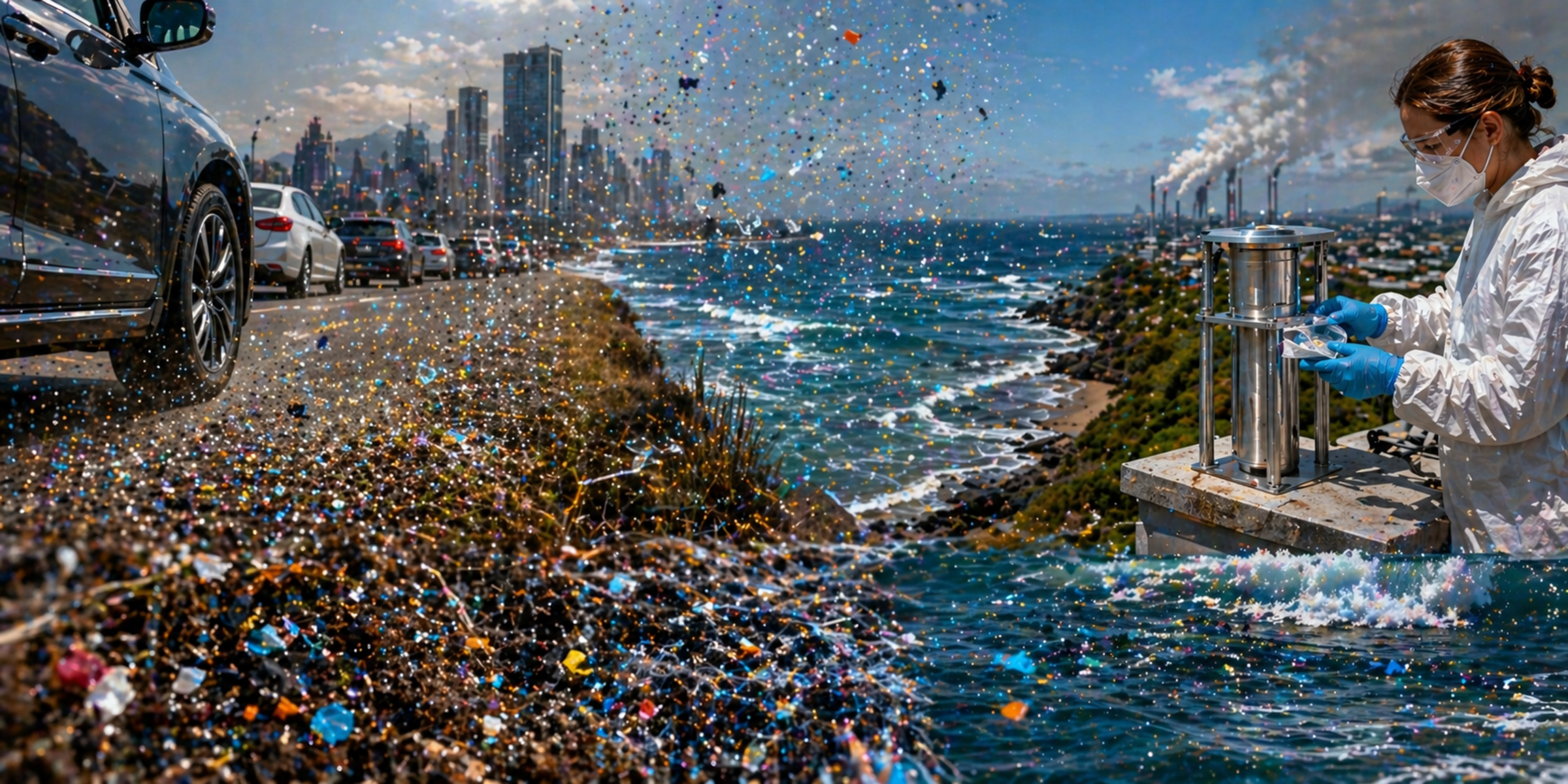
A new University of Vienna study used 2,782 real-world measurements of atmospheric microplastics and compared them with computer models. The big finding is that earlier models had massively overestimated how many microplastic particles are in the atmosphere, sometimes by several orders of magnitude.
The researchers found that land sources release more than 20 times as many airborne microplastic particles as ocean sources. These land sources include things like tyre wear, textile fibres, and contaminated land surfaces where particles can be lifted back into the air by wind or movement.
But there is an important twist. While land releases more particles, the ocean may release more mass, because ocean-emitted microplastic particles tend to be larger on average. So land dominates by particle number, while the ocean can still matter strongly when looking at total plastic weight.
The study also challenges earlier thinking that the ocean was the main source of airborne microplastics. Instead, land-based pollution appears to be the bigger driver of tiny particles moving through the air and travelling long distances, even to remote places.
The researchers say there is still a lot of uncertainty. They need better data on how much comes from traffic, how much comes from other land sources, and especially the size distribution of the particles. That matters because particle size affects how far microplastics travel, how long they stay airborne, and how much total plastic is being moved around the planet.
In plain English: we now know land is likely the main source of airborne microplastic particles, but scientists still do not know the exact scale of the problem. The study is a big step forward, but it also shows how much more measurement is needed.