
SpaceX’s IPO Could Put Bitcoin on the Balance Sheet of the Most Valuable Public Company in the World but That Still Would Not Make It a Real Bitcoin S
10 min readApr 5, 2026
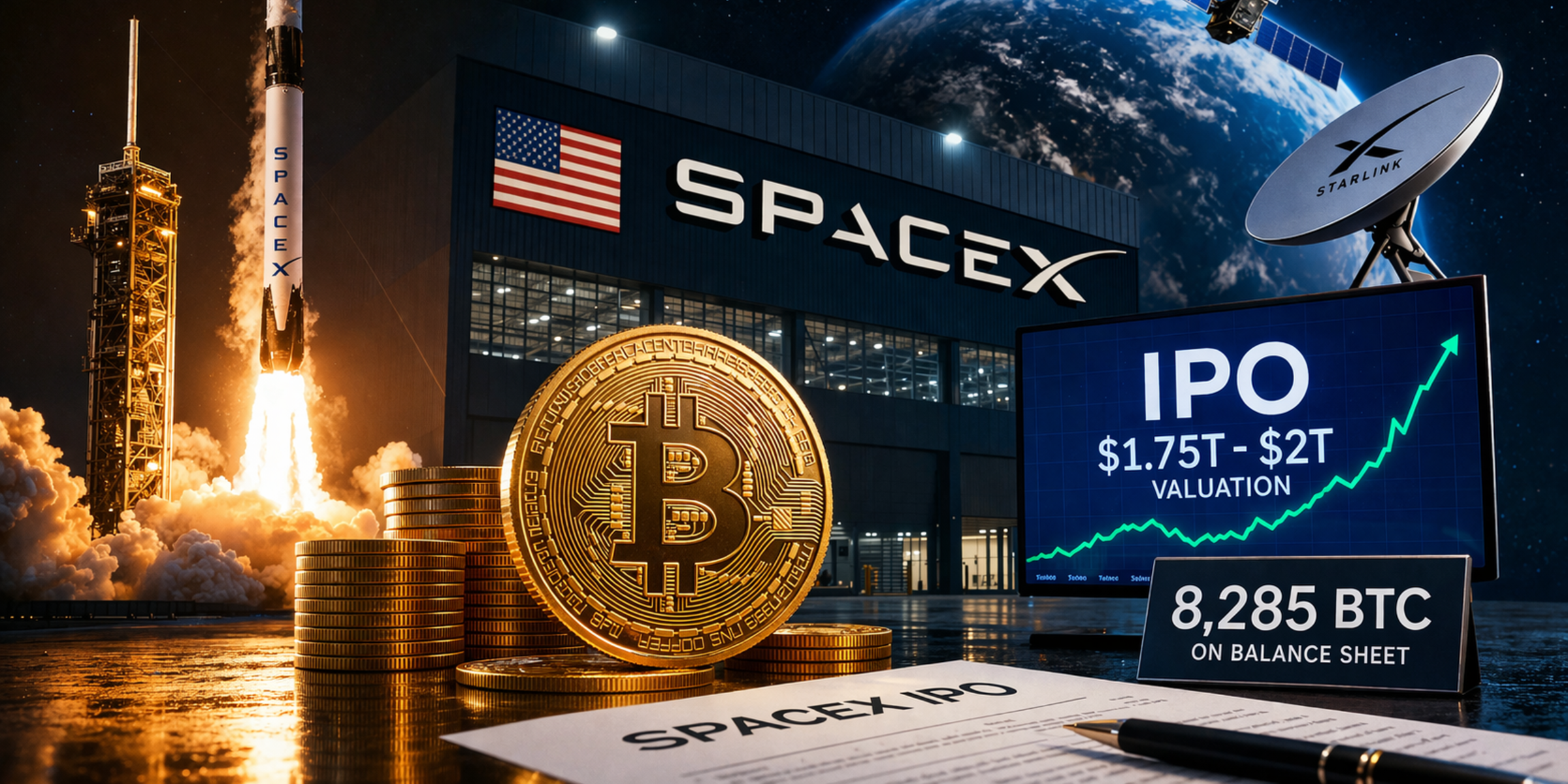
For years, public market investors who wanted Bitcoin exposure through equities have usually had to choose between two very different kinds of vehicles. One group was built around Bitcoin itself, treasury companies, miners, ETFs, and firms whose market identity is directly tied to the asset. The other group held Bitcoin more incidentally, as one item on a much larger corporate balance sheet. SpaceX could soon become the most dramatic example of the second category ever seen. Reports this week say the company has confidentially filed for an IPO that could value it anywhere from roughly $1.75 trillion to above $2 trillion and raise as much as $75 billion. If that happens, a company already reported to hold about 8,285 Bitcoin would suddenly bring one of the largest private corporate BTC positions into public markets at a scale no listed Bitcoin holder has ever matched.
That headline is powerful for obvious reasons. A public SpaceX with Bitcoin on its balance sheet would instantly become the most valuable listed company holding the asset, far eclipsing Tesla in market value while still holding less Bitcoin in absolute terms than some of the market’s more explicitly crypto aligned firms. That makes for a great narrative because it puts Bitcoin inside one of the most coveted equity stories on earth. It says something important about how far the asset has travelled. A rocket and satellite giant at trillion dollar scale can now plausibly sit beside Bitcoin without the pairing sounding absurd. But there is a second story underneath the excitement, and it matters just as much. SpaceX would not become a Bitcoin company in the way many crypto investors instinctively imagine. It would become a space, telecom, and increasingly AI infrastructure company that happens to have Bitcoin on the balance sheet.
The IPO itself already looks historic before Bitcoin even enters the picture
The first fact to keep straight is that the IPO alone is huge enough to dominate market attention whether or not anyone cares about crypto. Reuters reported that SpaceX has lined up a very large bank syndicate and is preparing for what could be the biggest stock market debut in history, with earlier talk around a $1.75 trillion valuation and later reporting saying the target could exceed $2 trillion. Reuters also said the company has been seeking anchor investors, including reported talks with Saudi Arabia’s Public Investment Fund over a possible $5 billion stake. That tells you the deal is not some speculative fantasy being floated by traders. It is being worked at an institutional level with the kind of seriousness that only a handful of companies ever attract.
That scale matters because it changes the meaning of the Bitcoin exposure. If a small or mid sized public company holds Bitcoin, the market can easily end up treating the whole stock as a loose crypto bet, especially when the operating business is weak or unclear. SpaceX is the opposite of that. Reuters says the company generated roughly $15 billion to $16 billion of revenue in 2025 and around $8 billion in EBITDA, with Starlink contributing most of the revenue and profitability. It dominates reusable launch economics, owns one of the most strategically important private communications networks in the world, and now sits inside an even broader Musk ecosystem after its merger with xAI. In other words, SpaceX would be a mega operating company first and a balance sheet Bitcoin holder second.
My view is that this is where many Bitcoin narratives will go wrong. Investors love symbolic overlap. They see a great company plus a Bitcoin treasury and immediately start imagining a hybrid equity that offers both operational growth and crypto upside in one neat package. But the market rarely prices those combinations so cleanly. If SpaceX comes public anywhere near the rumored valuations, its stock will live or die much more on Starlink economics, Starship progress, defense and NASA relationships, telecom growth, and AI adjacent ambitions than on a sub billion dollar Bitcoin stash. That does not make the stash irrelevant. It makes it context dependent.
Why the Bitcoin angle still matters more than it first appears
Even so, the Bitcoin part is not trivial. Data cited by CryptoSlate and BitcoinTreasuries.com place SpaceX at about 8,285 BTC, valued around $569 million to $570 million recently. That is not enough to drive a multi trillion dollar valuation on its own, but it is enough to make the company one of the more important corporate holders in absolute terms. More importantly, it would mean one of the world’s most closely watched public listings is carrying a visible Bitcoin treasury from day one. That has symbolic power because it normalizes Bitcoin ownership inside a company the market will likely treat as a premier industrial and technology asset, not a fringe financial experiment.
That kind of normalization matters more than many people admit. Bitcoin has spent years fighting two image battles at once. One was about volatility, scams, and regulatory discomfort. The other was about seriousness. Could the asset ever become a routine part of the financial and corporate background rather than a permanent outsider? A SpaceX listing with BTC on the balance sheet would not solve those questions outright, but it would push the seriousness case forward. Investors who would never buy a treasury company built around Bitcoin may soon own or follow a public company with Bitcoin exposure simply because they want exposure to rockets, satellites, broadband, and AI. That is a different path to mainstream acceptance.
My opinion is that this may be the most important part of the entire story. It is not that SpaceX would become a clean proxy for Bitcoin. It is that Bitcoin would become quietly embedded inside one of the market’s most prestigious equity narratives. That kind of embedding can be more durable than loud ideological adoption because it changes the background assumptions of mainstream investors. Bitcoin stops being a special case and becomes one more line item inside a company everyone already takes seriously.
Why SpaceX would still not function like a proper Bitcoin proxy
This is where the excitement needs discipline. The phrase “Bitcoin exposure” can cover very different realities. There is a huge difference between a company whose valuation is materially driven by Bitcoin and a company that merely owns some. SpaceX falls overwhelmingly into the second category. At a reported Bitcoin position worth a little under $600 million, the treasury would be economically tiny relative to a possible valuation of $1.75 trillion or more. Even at the lower rumored valuation, the BTC holdings would amount to only a few hundredths of one percent of enterprise scale. That is not enough to make the equity a meaningful substitute for holding Bitcoin directly.
That distinction matters because public markets have already shown how differently they treat crypto aligned equities. Some listed firms are bought precisely because investors want levered or operationalized Bitcoin exposure. Their treasuries, issuance models, or revenue streams are so tied to Bitcoin that the stock almost becomes a market view on the asset itself. SpaceX would not live in that category. Its shareholder base would likely be dominated by people thinking about launch cadence, Starlink cash flow, space infrastructure, and AI optionality. Bitcoin might be a curiosity, a bonus, or a talking point, but not the central valuation pillar.
My view is that this is actually healthy. The market does not need every company with Bitcoin on its balance sheet to become a de facto crypto wrapper. In fact, the stronger signal may be that a world class operating company can hold BTC and still be judged primarily on its real business. That makes Bitcoin look less like a desperate financial crutch and more like a legitimate treasury asset that can sit beside other corporate resources without hijacking the whole story.
The xAI merger makes the story even stranger and larger
There is another layer here that makes the potential IPO even more unusual. Reuters and other reporting say SpaceX merged with xAI earlier this year, folding Musk’s AI ambitions more directly into the company’s wider public market narrative. Reuters described xAI as a subsidiary and noted that it had posted a $1.46 billion net loss in the third quarter of 2025, even as SpaceX remained profitable and revenue rich. That creates a more complex listing than a simple space company IPO. Public investors would likely be buying into a mix of launch services, satellite communications, broadband cash flow, speculative space infrastructure, and AI. That combination alone could justify a premium or create confusion, depending on how the prospectus frames it.
This matters for the Bitcoin conversation because it further dilutes the idea of SpaceX as any kind of clean BTC equity. The company is becoming more multi narrative, not less. Investors may price in Starlink as a utility growth story, Starship as a moonshot industrial platform, xAI as an embedded AI optionality layer, and only then look at the Bitcoin holdings as a small but interesting extra. If anything, the merger makes the stock even more likely to trade on grand Musk ecosystem expectations rather than on any discrete treasury feature.
My opinion is that this is another reason the “Bitcoin proxy” framing is too simplistic. SpaceX’s public market identity, if the IPO happens, would likely be one of the most overdetermined stories in modern equity markets. It would carry space, defense, telecom, AI, and Musk premium all at once. Bitcoin would sit inside that mix, but it would not define it. That can still be bullish for Bitcoin’s legitimacy without making the stock a useful substitute for direct BTC exposure.
What this could mean for public market psychology around Bitcoin
Even if the treasury is too small to define the stock, the psychological effect could still be large. Public investors often learn through association rather than argument. If a prestige listing of this scale includes Bitcoin on the balance sheet and the world does not end, that quietly shifts the baseline. Bitcoin becomes less exotic. It becomes something a premier company can hold without that fact overwhelming the investment case. That is how financial normalization often works. Not through one decisive conversion moment, but through repeated contact with elite institutions, blue chip narratives, and ordinary portfolio language.
There is also a broader market structure angle here. A successful SpaceX IPO is already being described by Reuters as a possible catalyst for the wider U.S. IPO market, a make or break test for mega listings after years of drought. If that deal carries Bitcoin onto public screens at the same time it reopens appetite for giant growth stories, the association could benefit the asset indirectly. Not because investors are buying SpaceX for Bitcoin, but because Bitcoin appears inside a moment of market reopening and institutional confidence rather than inside a defensive or fringe narrative.
My view is that this is probably the best case interpretation for Bitcoin bulls. Not “SpaceX will moon because of BTC,” but “BTC will look more ordinary because SpaceX carries it.” That is less exciting in the short term and more meaningful in the long term. It suggests Bitcoin is migrating from special event status toward treasury background status inside major companies, even if that process remains uneven and relatively rare.
The market could still overread the Bitcoin angle
Of course, there is a risk that traders do exactly what traders always do and overread the smallest dramatic element of the story. The moment the filings confirm the Bitcoin holdings, there will almost certainly be attempts to pitch SpaceX as a fresh public route into BTC exposure. That can help headlines, social media, and retail excitement, but it may also create a misunderstanding about what buyers are really owning. A multi trillion dollar space and telecom company with a moderate Bitcoin treasury is not equivalent to a treasury company, a miner, or a spot ETF. If investors treat it that way, the disappointment later will be theirs, not the company’s.
This is why I think the cleanest way to understand the potential listing is as a symbolic Bitcoin milestone rather than a functional Bitcoin vehicle. The symbolism is enormous. The functional exposure is modest. Both things can be true at once, and in fact that tension is what makes the story so interesting. It shows how far Bitcoin has penetrated elite corporate balance sheets while also showing the limits of that penetration when the host company is vast enough that the treasury no longer dominates the identity.
The bigger point
The facts are striking enough on their own. SpaceX is reported to have filed confidentially for an IPO that could value it from around $1.75 trillion to above $2 trillion, and the company reportedly holds about 8,285 Bitcoin worth roughly $570 million. If listed on that basis, it would become the most valuable public company holding Bitcoin on its balance sheet.
But my judgment is that the deeper story is not that SpaceX would become a giant Bitcoin stock. It is that Bitcoin would become a small but undeniable part of one of the most important public equity stories in the world. That is a very different kind of win. It is quieter, more institutional, and in some ways more important than the market may initially realize. A SpaceX IPO would not prove that public investors now want every great company to be a crypto proxy. It would prove something subtler and perhaps more durable: Bitcoin has become normal enough to sit on the balance sheet of a world defining company without becoming the whole point of owning it