
Spirit of Tasmania berth progress is real, but the bigger test is still trust
Now Tasmania needs more than progress. It needs proof that this project will finally land.
9 min readApr 21, 2026
The latest update matters because it feels concrete
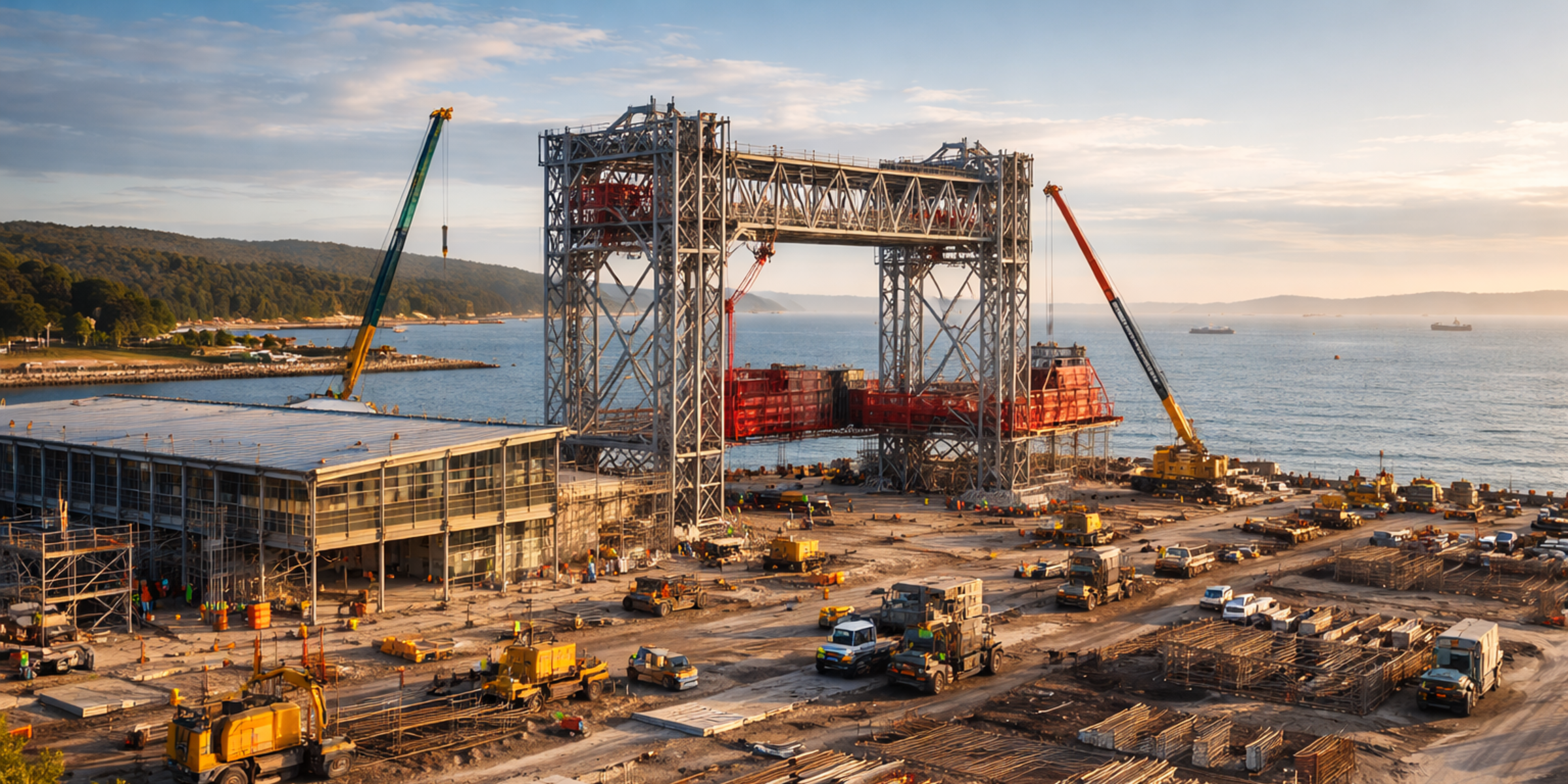
For a long time, the Spirit of Tasmania replacement story felt like one of those big infrastructure sagas where the numbers changed, the dates slipped and the public was asked to wait for another explanation. That is why the latest update out of East Devonport matters. On April 20, 2026, the new Berth 3 terminal was described as on track for an October launch, with the fourth of seven sections of the 700-tonne gantry now installed. The minister said the main terminal building, stevedoring building and landscaping were all progressing well, while TT-Line staff also said operational work behind the scenes was moving ahead for an end-of-October launch window.
That kind of update lands differently because it is physical. It is not just another planning milestone or another line in a committee document. A giant gantry going up on site is visible proof that the job is moving toward a working berth, not just another revised schedule. In a project that has spent years being defined by what was missing, visible progress matters politically, commercially and psychologically. People can finally look at the site and see something taking shape that resembles an ending, not another delay.
This project has become bigger than a berth
The berth itself is only one piece of the story. What has made this project so sensitive is that it has become a symbol of how Tasmania handles major infrastructure linked to its tourism and freight lifeline. TasPorts describes QuayLink at Devonport as a $240 million investment to upgrade East Devonport and future-proof the port as a tourism gateway for the next 50 years, with project assumptions tied to a 40 percent increase in freight capacity and another 160,000 passengers visiting Devonport each year once the new vessels are fully in the picture. TasPorts also makes clear that its $240 million covers only the port-side QuayLink works, while tenant-specific works are being delivered by operators such as TT-Line.
What this really means is that the berth is not just a concrete and steel problem. It is part of a much larger promise about Tasmania’s economic future. The ferries are not a niche transport issue. They carry tourists, caravans, motorhomes, freight, locals, families, workers and trade. When people talk about Spirit of Tasmania, they are really talking about the state’s connection to the mainland in one of its most practical forms. That is why the new berth has become such a loaded subject. If it works, it supports a stronger tourism and freight story. If it fails again, it feeds a deeper anxiety about execution, governance and public confidence.
The damage was done long before this week’s milestone
The reason this story still carries tension is that the public memory has not vanished. The parliamentary interim report from November 2025 described the vessel replacement project as one marked by multiple design, management and supplier changes, associated cost increases, governance failures and inadequate oversight. The report said the failure to have a suitable berth ready before the vessels were available had delayed the new ships entering service until at least October 2026, even though they were originally promised for 2021.
That is the backdrop to every positive update now. No matter how encouraging a new construction milestone may be, people are reading it against the memory of what already went wrong. This is why the story still feels raw. It is not just that the berth was late. It is that the whole sequence made Tasmania look like it had bought the future before building a place to put it. That kind of error is easy for the public to understand, which is part of why it cut so deeply. It did not look like a technical planning mistake. It looked like the basics had been missed.
The cost story still hangs over everything
Any honest reading of the project has to acknowledge the cost side too. The berth and terminal story has not only been about delays. It has also been about blowouts on a scale that changed how the public saw the whole project. By early 2026, TT-Line was telling Parliament it remained on track to deliver Berth 3 within a revised budget of $493 million, while earlier reporting traced the berth infrastructure cost out from much lower early expectations and showed how far the project had moved from its original framing.
The problem is that once a project becomes associated with that kind of cost escalation, every subsequent update carries two questions. Is it really on time now, and is it really under control now? The state may be closer to the finish than it has ever been, but the financial memory does not disappear just because the gantry is going up. In big public projects, trust is not restored by one good month on site. It is restored by consistent delivery against the latest promise, and by doing that long enough that people stop bracing for the next nasty surprise.
The ferries waiting in the wings made the pressure worse
Part of what turned this into such a public embarrassment was the timing mismatch between ship readiness and berth readiness. In February, reporting noted that Spirit of Tasmania IV had been anchored in Geelong at a cost of almost $900,000 a month. In March, TT-Line said the ship had been moved to Nelson Pier at Williamstown to reduce fuel use and support required hull strengthening work, with the company saying it expected the vessel to come to Tasmania for testing once the gantry in Devonport was completed. Spirit of Tasmania V also left Scotland in March for its journey to Australia, while the broader story remained that the vessels were arriving before their proper home infrastructure was ready.
That made the berth project impossible to treat as a quiet construction matter. The ships were real. One was sitting there costing money. The other was on the move. People could see the absurdity of owning major new vessels while still racing to complete the terminal and berth that would actually let them start work as intended. It turned what might otherwise have been an inside-baseball infrastructure delay into a kitchen-table conversation. The public did not need a procurement background to understand the problem. The product had arrived before the parking spot was finished.
There is now a clearer target in sight
For all that history, the current timetable is more tangible than it has been for a long time. The state shifted the expected Berth 3 completion target to October 2026 in May 2025, bringing it forward from the previously flagged February 2027 timeline. TT-Line has since opened Stage 1 bookings for the new ships from October 31, 2026, while also making clear that the exact final changeover from the current vessels to Spirit of Tasmania IV and V is still being finalised. In other words, the public-facing plan now has a date range, a booking pathway and a visible construction program rather than just broad intent.
That matters because certainty creates a different mood. For months the story was dominated by questions of whether there even was a believable endpoint. Now the discussion is shifting toward whether the October window can hold and whether late-2026 service can actually be delivered in a way that feels smooth, not rushed. That is progress, even if it is not yet victory. A believable deadline changes behaviour. Travellers start thinking about bookings. Operators start thinking about readiness. Tasmania starts thinking about the coming summer not just as a political risk, but as a test of whether the project can finally begin paying back some of the patience it has consumed.
The new ships are not just newer, they change the economics
This is another part of the story that deserves more attention. The new ships are not just replacements in the simple sense. They are materially larger and more capable. TT-Line says Spirit of Tasmania IV and V can each carry up to 1,800 passengers and provide 4,098 lane metres for vehicles, compared with roughly 1,400 passengers and 2,565 lane metres on the current ships. The company is also selling the new vessels around added accommodation variety and more space for larger vehicles such as caravans and motorhomes.
What this really means is that the berth project is tied to a much bigger operating model than the one Tasmania has now. More capacity changes the freight equation, the tourism equation and the demand equation. It potentially gives the route more breathing room, more commercial upside and more seasonal flexibility. That is why the berth being late has been so costly in more ways than one. The state has not just been waiting for an asset to be finished. It has been waiting for the larger capacity and economic uplift those ships were supposed to unlock. Every delay has therefore been both a cost problem and an opportunity problem.
The local angle matters too
One reason the latest update has landed well in Tasmania is that it carries a local texture people actually care about. The state says the terminal is being built with locally sourced timber by Vos Construction and Joinery, and the project has been framed as supporting Tasmanian jobs while building out a new gateway asset. That may sound like standard government language, but in a project this bruised, those details matter because they reconnect the build to local pride rather than only political damage.
Tasmania has always cared about Spirit of Tasmania in a personal way. It is not an abstract brand here. It is how families travel, how freight moves, how visitors arrive, how caravanners come across, how locals cross Bass Strait with their cars, and how the island presents itself as accessible but still distinct. So when the berth story starts to include visible local building work, timber, trades and an active Devonport site, it feels more like something belonging to the community again and less like a floating scandal. That emotional shift will not erase the mistakes, but it does help explain why people are watching these recent milestones closely.
The real issue now is execution under pressure
The job is not finished, and that is the part everyone needs to keep in mind. The terminal buildings still have to be completed. Systems still have to be integrated. The gantry still needs the remaining sections installed. Operational readiness still has to line up with physical readiness. The changeover from current ships to the new vessels still has to be finalised. TT-Line is selling sailings from October 31, 2026, but it also says those are not necessarily the inaugural sailings, because the final transition plan is still being worked through.
The problem is that the closer a delayed project gets to the end, the more pressure there is to declare it effectively done before every part of the system is truly settled. That is where discipline matters. Tasmania does not need another rush to present good news. It needs a clean, working transition that can stand up in practice. There is a difference between a launch window and a successful operating start. The public has already seen what happens when optimism runs ahead of readiness. No one should want a repeat of that dynamic in the final months.
What happens next will shape the political memory
Big infrastructure stories are often remembered less for the precise details of what went wrong than for how they ended. If Berth 3 is completed on the current October target, if the ferries begin service cleanly, and if the route starts delivering the extra capacity Tasmania was promised, then public memory of this saga will soften over time. The project will still be studied as a major failure of planning and governance, but it will also become a story with an ending. If the current target slips again, the political memory hardens in the other direction and the project becomes a standing example of how not to manage major public infrastructure.
That is why this moment matters more than the steel itself. Tasmania is now in the narrow stretch where progress has finally become visible, but final proof is still ahead. The fourth gantry section going in is real. The site activity is real. The booking window is real. The economic upside of the bigger ships is real. But the state has spent too long living with this saga to hand out trust early. The only thing that will truly close this chapter is delivery. Not another explanation. Not another milestone. Delivery.